


Please consider supporting our mission to help everyone better understand and become smarter about the Jewish world. A gift of any amount helps keep our platform free of advertising and accessible to all.
This is a guest essay by Vanessa Berg, who writes about Judaism and Israel.
You can also listen to the podcast version of this essay on Apple Podcasts, YouTube Music, YouTube, and Spotify.
Following October 7th, there is no Jewish holiday more difficult to understand than Simchat Torah. And there is no Jewish holiday more necessary.
Simchat Torah is, on its surface, absurdly joyful. We take the Torah out of the ark, hold it against our bodies, circle the synagogue, sing, clap, drink, and dance. Children sit on their fathers’ shoulders. Old men who move slowly all year somehow find enough strength for another hakafah (meaning “circling” or “going around” in Hebrew). The Torah scroll itself effectively becomes secondary to what happens around it.
For most of the year, Judaism asks us to read the Torah, argue with it, wrestle with it, and study its literal, figurative, and spiritual interpretations. On Simchat Torah, Judaism asks us to do something much less intellectual and perhaps much more revealing: Hold it close and move. We dance because there are some things too deep to explain.
Then came October 7th. It was Simchat Torah morning in Israel when Palestinian terrorists crossed the border from Gaza and entered Israeli communities. Families were murdered in their homes, kibbutzim became battlefields, and more than 250 people were dragged into captivity.
Only a few kilometers away, thousands of young Israelis had gathered for the Nova music festival. They, too, had come to dance. They were not soldiers assembling for battle or politicians making a statement. They were young people gathered beneath an open sky, listening to music as the sun began to rise over the Negev.
Some came with lifelong friends, some with partners, and some probably barely knew anyone there. They had arrived for the most ordinary and ancient of human reasons: to lose themselves for a few hours in music, movement, connection, and joy.
Then the music stopped, replaced by gunfire and screaming. Hundreds were murdered; others were wounded, hunted through fields, or taken hostage, and a festival built around dancing became one of the defining battlegrounds of October 7th.
It is difficult to imagine a more brutal collision of symbols. Simchat Torah literally means “the joy of Torah,” and its defining ritual is dancing. Jews carry Torah scrolls around in circles, traditionally completing seven hakafot, returning again and again to the place from which they began. Even the Torah reading itself is circular.
On Simchat Torah, we read the final verses of Deuteronomy. Moses dies. The Torah reaches its final sentence. Then, almost immediately, another scroll is opened and we begin Genesis — Bereishit in Hebrew, meaning “in the beginning.” Judaism does not permit the story to remain at its ending. Death is followed by creation. The final sentence is followed by the first. The book closes and opens at virtually the same moment.
After October 7th, that ritual no longer feels merely liturgical. It feels like a description of Jewish history. Few peoples have been forced to begin again as many times as the Jewish People. Jerusalem was destroyed, and Jews began again. We were exiled, and we began again. We were expelled from Spain, massacred in pogroms, and nearly annihilated in Europe, and still we began again.
Beginning again did not mean pretending that what happened was insignificant. It did not mean forgetting the dead, explaining away catastrophe, or declaring suffering meaningful simply because something came afterward. Jewish renewal has never required Jewish amnesia. Quite the opposite: We begin again while carrying what happened before.
That is what makes the physical ritual of Simchat Torah so powerful. A Torah scroll is heavy. Depending on its size, it can weigh dozens of pounds, and during the dancing someone places that weight into your arms and you hold it tightly against your chest as you move.
There is no better metaphor for Jewish joy. Jewish joy has rarely been weightless. Jews have always danced carrying something: history, memory, exile, loss, names, obligations, promises. We do not set those things down in order to celebrate. We take them into the circle with us.
After October 7th, that image became unbearable. When Jews dance on Simchat Torah now, whether they consciously intend to or not, the circle contains people who are missing. It contains the young people from Nova, the families of Be’eri and Kfar Aza and Nir Oz, the soldiers who fell, the hostages who were taken, and the thousands of people whose lives were permanently divided into a before and an after.
For some families, the date of Simchat Torah itself has become inseparable from the worst day of their lives, which creates a painful question: How do you dance on the anniversary of a massacre? How do you sing on a date when someone else lost a child, a sibling, a spouse, or a friend?
And maybe the deeper question is not how Jews can dance, but why Jewish tradition has always insisted that we must.
There is a common misunderstanding about joy that treats it as the opposite of grief, as though one emotion invalidates the other. Either you are mourning or celebrating; either you are broken or happy.
Judaism has rarely accepted such clean divisions. At a Jewish wedding, at the height of celebration, a glass is smashed in memory of Jerusalem. At the Passover seder, we diminish the wine in our cups as we recount the plagues, tempering our joy at liberation with the suffering inflicted on the ancient Egyptians.
Jewish ritual repeatedly refuses to let happiness erase history. We bring the broken glass to the wedding. We bring memory to the feast. We bring death into the final verses of Torah, and then we dance.
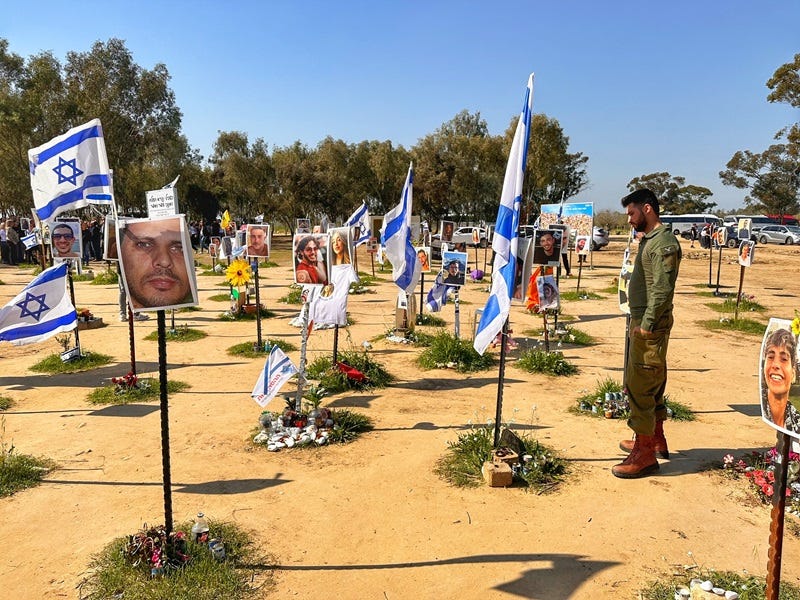
Judaism learned something very early about what survival would require. If joy were permitted only after pain had disappeared, a people with Jewish history might never be allowed to experience joy at all. Jewish joy therefore became something more complicated and, in a sense, more defiant. It is the refusal to allow what happened to become the only thing that is true.
That is where Simchat Torah and Nova meet most powerfully. The young people at Nova were dancing before the massacre. One of the great questions after the massacre was whether Israel would ever dance the same way again. Almost immediately, a phrase began appearing at memorials, concerts, gatherings, on walls, on shirts, and in the language of survivors: “We will dance again.”
At first glance, it sounds small, a promise that there will be another party, another festival, another night of music. In reality, it is a statement about what terrorism is trying to accomplish and what surviving terrorism ultimately means.
Terror does not only try to kill people. It tries to govern the imagination of those who remain. It tries to make the concert frightening, the café dangerous, the bus suspicious, the public square vulnerable, the ordinary pleasures of life permanently haunted. It wants the survivor to reorganize life around fear.
That is why surviving an attack can never be the complete answer to terrorism. Eventually the café has to reopen, the children have to return to school, the music has to play, and people have to dance. Otherwise the murderer continues shaping the lives of people he failed to kill.
This gives Jewish dancing a significance that extends far beyond celebration. A Jewish circle dance is a peculiar thing. There is no front, no stage, and usually no single performer. Everyone moves together. One person knows the steps and another does not. Someone enters and the circle widens. Someone stumbles and the movement absorbs it. For a moment, individual bodies become part of a collective rhythm.
It is difficult not to see in that something resembling Jewish peoplehood itself — Jews come from Tehran and Tel Aviv, Los Angeles and Paris, Buenos Aires and Melbourne. Some know every prayer and some know almost none. Some believe deeply and others wrestle constantly with belief. Yet somehow, across centuries and continents, the circle has continued.
That is why dancing on Simchat Torah after October 7th brings October 7th into the circle. We carry the weight, the names, the people who should have been there, and the questions that remain unanswered. Jewish life has never depended on forgetting suffering; it has depended on refusing to let suffering become the total definition of Jewish existence.
The Jewish People have done this again and again.
We buried our dead and then built homes. We fled one country and created communities in another. We mourned and then married and made more Jewish babies. We remembered destroyed cities and then raised these babies who would never see those cities. We planted trees after wars, opened businesses after pogroms, founded universities after exile, and created a Jewish state just three years after the Holocaust.
We did not survive because we were untouched by history. We survived and, again, thrived because destruction never received the final word.
That is why Nova and Simchat Torah now seem permanently bound to one another. On one day in October 2023, Jews were murdered while dancing on the Jewish holiday of dancing. It is difficult to imagine anything crueler, but it also creates an obligation that reaches beyond memorial: The Jewish answer is that the dancing begins again.
More than a thousand years ago, Jews created a ritual in which we would finish our sacred story and immediately return to its beginning. We would mark that transition with music and movement, while carrying our beautiful stories, lessons, and commandments. We would dance in circles so that no ending could ever quite become final.
After October 7th, that ritual feels less like symbolism and more like instruction. When the music stops, remember why it stopped; remember who was there; remember who is missing; and do not pretend the weight has disappeared.
Then pick it up, join the circle, and dance again.
I have always loved this about Israel.
The most joyful nation of all. 🙏
I really appreciated reading your piece, especially the concept of beginning again. In many ways, it feels like not only have we done this as a nation, as you have described, but many of us have done the same in our personal lives too.
It’s all about the ups and downs.