


Please consider supporting our mission to help everyone better understand and become smarter about the Jewish world. A gift of any amount helps keep our platform free of advertising and accessible to all.
This is a guest essay by Rivka Hellendall, a Dutch-born writer based in Israel since 2021.
You can also listen to the podcast version of this essay on Apple Podcasts, YouTube Music, YouTube, and Spotify.
Amsterdam is the only big city I ever lived and felt at home in as an adult before I moved to that other big city of my life, Jerusalem.
Amsterdam, though, is a paradoxical city. It represents almost every kind of vice in the international imagination, yet this tranquil atmosphere has a way of bouncing off the still canal waters. It’s a metropolis that doesn’t feel like one. It feels, for lack of a better word, strangely quaint. Or, Amsterdam wants nothing more than to be quaint despite its heady appeal, like an R-rated Disney World of sorts.
“We don’t care what antics you get up to, as long as don’t kill our cozy vibe” has effectively been Amsterdam’s unofficial motto for centuries. However, said vibe is now dead in the (canal) water for the city’s Jews. The city that welcomed the forebears of, say, philosopher Baruch Spinoza on the condition of not harshing the vibe has again turned on its oldest and most influential minority.
But what about that other, arguably even more famous Amsterdam inhabitant, a certain Anne Frank? Make no mistake: This ubiquitous Holocaust icon was no Dutch teen in her lifetime. She was born in Frankfurt, Germany and arrived in Amsterdam at 4 years old, but the Frank family became officially stateless when the Nazis took away their German citizenship in 1941.
Anne, her sister Margot, and her mother Edith perished in Bergen-Belsen without any nationality to their name, let alone the Dutch. Any kind of Dutch appropriation of her as a symbol that somehow reflects positively on the culture is ultimately absurd. And yet, this is how she is informally represented in the city these days:
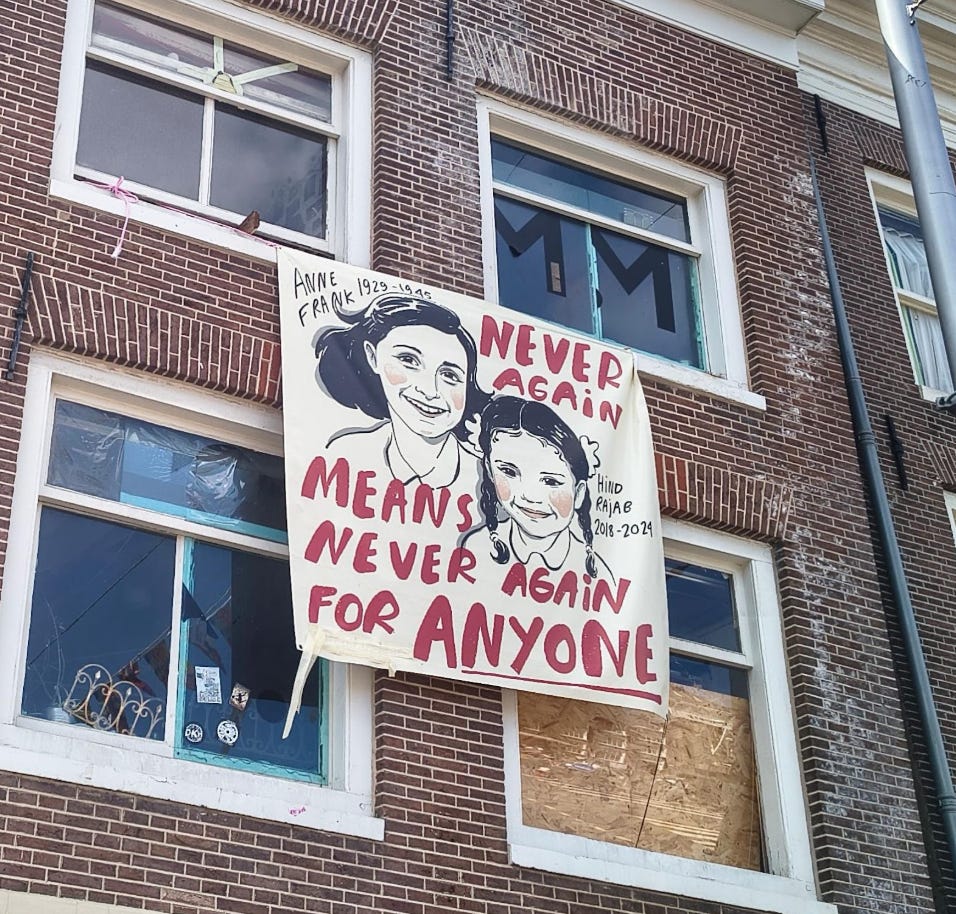
This poster of Anne Frank juxtaposed with Palestinian girl Hind Rajab has been on prominent display in the city center for almost a year, which is when I saw it first. Hind Rajab died in Gaza in January 2024 after her family’s car came under allegedly Israeli fire. (The Red Crescent accused Israel of deliberately targeting the family. Meanwhile, the IDF claims it had no troops deployed in the area, implying that other actors killed the family, such as Hamas operatives, who repeatedly fired at locals trying to flee combat zones throughout the two-year war).
Six-year-old Hind quickly became an international symbol of Gazan suffering. The city of Amsterdam requested that the EYE Museum project her photo for weeks in a gesture of solidarity. This took place after Mayor Femke Halsema stated she’d prefer to “keep the [Israel-Hamas] conflict out of Amsterdam.” Of course, that statement did not apply after her constituents were happy to throw Israelis into the canals in an outright pogrom only two months earlier.
I have not been able to find anyone speaking out against the above poster anywhere, but I find it particularly egregious within its historical context. Children’s deaths are always tragic, but Israel did not kill young Hind because she was Palestinian. She was a casualty of war, which is terrible enough because war always devastates innocent lives. However, that does not make her a victim of genocide, unlike Anne Frank and unlike what much of the Left has been saying since October 7th.
Conversely, Hamas did kill 5-year-old Ariel and 9-month-old Kfir Bibas (five years old and not yet one respectively) because they were Jewish, and with their bare hands no less. If Anne had been born Adi Efraimi in Kibbutz Nir Oz in the 21st century, Hind’s proverbial neighbors would have sent Adi to her death all over again, no questions asked.
Had Hind been born in one of Jerusalem’s Arab neighborhoods instead of Tel al-Hawa, Gaza City, she would have grown up just fine. She would be a bank teller or a pharmacist or a brilliant med student or any profession that Arab Israelis succeed at every day. Anne and Hind are not interchangeable, nor did they ever exist on the same plane to begin with.
Yet clearly, there are modern-day Amsterdammers who are happy to deploy the memory of Anne Frank as a weapon against Israel without a trace of embarrassment — the very country that fell victim to antisemitic mass murder on October 7th. At its root, this is the same antisemitism that condemned Amsterdam’s Jews to death 80 years before. I know more Dutch Jewish families than I’d like to admit who have taken down their mezuzah in the past two years. When I come visiting wearing a yellow hostage pin on my winter coat, local Jews often see it as “brave” in most non-Jewish spaces. It takes an especially emboldened man to wear a kippah in public and most vanish underneath either baseball or newsboy caps anywhere outside the synagogue.
Even now that the war with Gaza is smoldering more than it is burning, the anti-Israel propaganda voices don’t let up. I took the following pictures a few days ago:
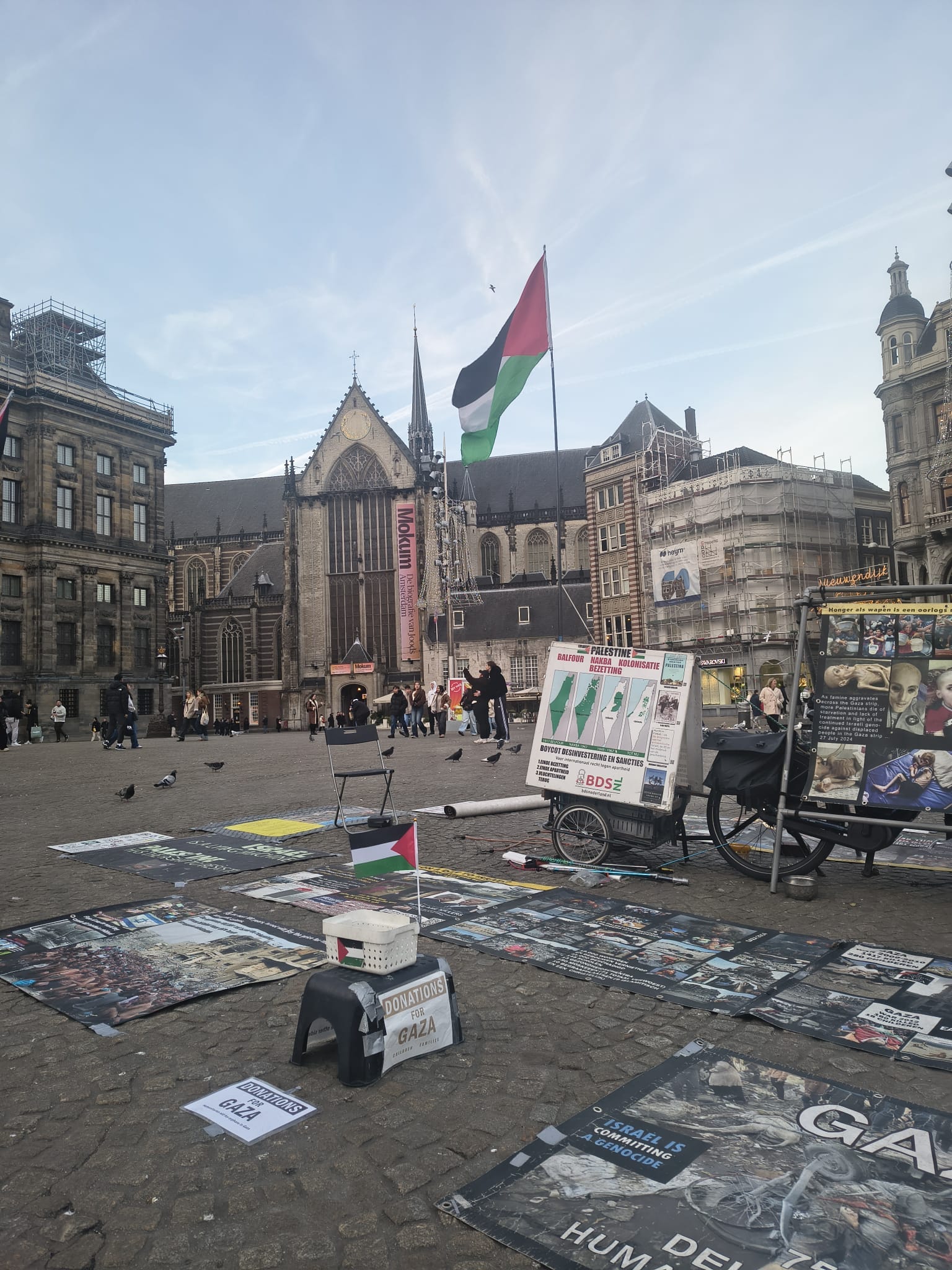
This was in Dam Square, the heart of Amsterdam’s old city. It’s the exact location where 2024’s pogrom against Israeli soccer fans broke out. As I took this picture, there was a megaphone blasting the cries of (supposedly) Palestinian babies across the square. The New Church, which stands directly in the background, shows a pinkish “Mokum” banner for its most current exhibit on, of all things, the history of Dutch Jewry in Amsterdam.
The name “Mokum,” for those in-the-know, comes from the Hebrew word makom, literally meaning “place.” Dutch Jews bestowed this loving nickname on the city when it was still kind to them. How are average passersby supposed to square the visuals of a historic exhibit on Jewish Amsterdam (which had roughly 80 percent of its population murdered in the Holocaust) with demonstrations that ratify the pervasive notion of Israelis as bloodthirsty and genocidal? Dara Horn couldn’t have made this stuff up when she published the book “People Love Dead Jews” back in 2021.

Adding insult to injury, the Netherlands officially pulled out of Eurovision Song Contest because Israel is participating, as usual, this year. AVROTROS, a Dutch radio and television broadcaster that is part of the Dutch public broadcasting system, stated it wouldn’t broadcast the event due to “proven evidence of interference by the Israeli government during the most recent edition of the Eurovision Song Contest, in which the event was used as a political instrument.”
Fascinating stuff, given that AVROTROS is also state-funded. Do they also consider themselves a political organ for the Dutch government? Is all cultural campaigning on public broadcasting political? If AVROTROS would take issue with Dutch government politics, would they hypothetically (gasp!) boycott themselves?
Strangely, I don’t see that happening. The fact is, however, that the more the Netherlands demonizes diplomatic ties to Israel at large, the more contemporary Dutch Jews will suffer in the public landscape. No amount of museifying1 Dutch Jews and their history will change that.
To museify something is to freeze it in time — to preserve it behind glass, label it, aestheticize it, and strip it of danger, demand, or consequence. It is to turn living people into artifacts and living obligations into historical décor.
Jews, in this framework, are acceptable only once they are safely past-tense: once they are dead, symbolic, silent, and useful. Anne Frank can be projected, quoted, and repurposed precisely because she can no longer object. She can be made to stand for whatever the present moment requires, including narratives that would have endangered her had she lived to see them.
Hence, museification is not remembrance; it is avoidance. And history has already shown us what happens when Jews are loved only when they are no longer alive to live as Jews.
“Museifying” (or museify) means to treat something as a museum object, preserving, exhibiting, or memorializing it, often removing it from its original context to become an artifact for study, display, or contemplation, but it can also relate to becoming lost in thought or making something artistic/inspiring.

Any juxtaposition of Anna Frank with anything at all pertaining to Gaza is an abomination and an attempted debasement of both the Holocaust and the State of Israel, imputing the blood-libel accusation of " genocide" on Israel .
The photo of the Gazan girl should have been accompanied by a photo of Hamas, and the photo of Anna Frank should have been accompanied by a photo of Hitler.
Demagoguery is taking unrelated levels of multi-level issues and falsely presenting single items linearly as if they were equivalent.
Example of such fallacy, which counts on ignorance and stupidity :
The Nazis killed people.
Israel killed people.
Israel is Nazi.
Never again means:
no more Hitlers.
No more Hamas.
No more Amsterdam and/or Dutch Jew haters.
No more Jews slaughtered without appropriate response.
The Gaza war - a war, not a genocide- was and is justified. Israel was savagely attacked.
The Holocaust, a genocide, was not justified. The Jews didn't attack Hitler or Germany or anyone.
There are many levels and unrelated histories. The fraudulent propaganda simplification of these girls' histories shows the inhuman, both Orwellian and deviously
Machiavellian intent of the pro- terrorism and Jew -hating Soviet inspired demagogues.
With apologies to the great Dara Horn, if there is one thing people love more than dead Jews, it is defenseless ones.