


Please consider supporting our mission to help everyone better understand and become smarter about the Jewish world. A gift of any amount helps keep our platform free of advertising and accessible to all.
You can also listen to the podcast version of this essay on Apple Podcasts, YouTube Music, YouTube, and Spotify.
There is a strange assumption many of us make about Jewish survival: We imagine that the greatest threat to Jewish identity is hardship.
Antisemitism. Persecution. Exile. Assimilation. War. Discrimination.
And certainly, Jewish history gives us plenty of reasons to think so.
But this week’s Torah portion, Parashat Eikev, presents a very different possibility. Perhaps the greatest spiritual danger does not arrive when everything is going wrong. Perhaps it arrives when everything is finally going right.
Eikev takes place near the end of the Torah, as Moses prepares the Israelites to enter the Land of Israel. The generation standing before him has spent decades wandering through the wilderness. They have lived with uncertainty, hunger, rebellion, miraculous rescue, and almost complete dependence on God.
Now that is about to change. They are going to have land, homes, food, crops, livestock, possessions, and security. And Moses is worried — not because he thinks the Jews will be unable to survive prosperity, but because he worries they will survive it so well that they will forget who they are. That may be one of the most important Jewish lessons for our own time.
Eikev contains some of the Torah’s most beautiful descriptions of the Land of Israel. Moses describes a land of wheat and barley, vines and figs, pomegranates, olive oil and dates. It is a land in which the Israelites will eat and be satisfied.
And then comes the warning: Once you have eaten your fill, built beautiful homes, increased your possessions, and accumulated silver and gold, be careful. Your heart may become arrogant. You may forget. And eventually you may tell yourself, “My power and the strength of my hand have made me this wealth.”
The Torah does not condemn success. It anticipates it. The problem is what success can do to our memory.
When we are struggling, dependence is obvious. We know what we lack. We know what we cannot control. We pray differently when we are frightened than when we are comfortable. But abundance creates an illusion. The successful person begins to believe that he created the entire chain of events that produced his success. I worked for this. I earned this. I built this. I deserve this.
The Torah responds with an extraordinarily precise formulation: Remember that God gives you the power to create wealth.
Notice what it does not say. It does not say that you did nothing. It does not tell us to deny ambition, discipline, intelligence, or effort. It asks us to remember where even those capacities came from. Your intelligence is yours, but you did not choose the brain you were born with. Your work ethic is yours, but you did not create every person who taught you discipline. Your business may be yours, but you did not invent the society, technology, infrastructure, customers, teachers, opportunities, and historical circumstances that made it possible.
Judaism asks us to hold two ideas simultaneously: Work as though your choices matter enormously, and remain humble enough to recognize that you are never the sole author of your success. That is a much harder theology than either helplessness or arrogance.
The very name Eikev contains another lesson. The word in the opening verse is usually understood as “because” or “as a result” — because the Israelites listen to the commandments, the covenant will continue. But eikev can also mean “heel” in Hebrew. The famous French rabbi and commentator Rashi famously connected the word to the commandments that people tend to treat lightly: the mitzvot (commandments) they figuratively “trample under their heels.”
There is something profound here about how Jewish identity actually works. Most people imagine that identity is shaped by enormous decisions. What do I believe? Am I religious? How Jewish am I? What are my politics? What do I think about Israel?
But a Jewish life is usually built much more quietly. It is whether you light candles on Friday night; whether you call your parents and grandparents; whether your children hear Jewish music in your home; whether there are Jewish books on your shelves; whether you know why Passover exists rather than merely attending a Seder, whether you learn a little Torah each week; whether you say a blessing before eating, whether you walk past the mezuzah without noticing it or allow it, occasionally, to remind you who you are; whether you consistently stay engaged with Israel.
Civilizations are built from grand ideas, but they survive through habits. The Jewish People did not survive for thousands of years because every Jew spent every morning contemplating Jewish theology. We survived because Jews baked certain foods, said certain words, remembered certain dates, taught certain stories, married into a people, mourned in certain ways, celebrated in certain ways, and performed thousands of seemingly small acts that quietly reinforced a gigantic idea: “I am part of something that began before me and must continue after me.”

Perhaps that is the deeper meaning of Eikev: Do not underestimate the things beneath your heel. The small things eventually determine the direction in which you walk.
Eikev also contains the biblical source for one of Judaism’s most revealing practices: Birkat Hamazon (grace after meals). “When you have eaten and are satisfied,” the Torah instructs, we should bless God.
The timing is fascinating. You might expect the Torah to tell us to pray when we are hungry. Instead, it specifically worries about us when we are full — because hunger naturally produces longing, and satisfaction produces forgetfulness. This is why gratitude in Judaism is not merely a feeling. It is a discipline.
Modern culture often tells us to practice gratitude because it will make us happier. Judaism goes further. Gratitude keeps us sane. It corrects our perception of reality. Without gratitude, every blessing slowly transforms into an entitlement. The extraordinary becomes ordinary.
The person who once prayed desperately for a spouse can eventually begin taking that spouse for granted. The person who dreamed of having children can eventually experience them mostly as an inconvenience. The immigrant who dreamed of freedom can raise children who barely understand why freedom matters. The entrepreneur who once begged for customers can become irritated that growth is not happening fast enough.
And a Jewish People who spent 2,000 years praying to return to Jerusalem can eventually produce Jews for whom Jewish sovereignty seems mundane.
Human beings are remarkably talented at normalizing miracles. Eikev tells us to fight that instinct, not through occasional inspiration, but through ritualized memory: Eat, become satisfied, then stop, remember, and bless.
This lesson has enormous implications for Jewish life today.
Many Jews become intensely Jewish when something terrible happens to Jews. An antisemitic attack occurs. Israel goes to war. A synagogue is threatened. A Jewish student is harassed. Suddenly Jews who rarely thought about their Jewishness feel something awaken inside them. There is nothing strange about that. Threat has always strengthened group identity, but it also creates a danger.
If the primary thing making us Jewish is the existence of people who hate Jews, then we have outsourced Jewish identity to our enemies. They decide when we feel Jewish. They decide when we gather. They decide when we care about Israel. They decide when we learn our history. They decide when Jewish peoplehood becomes important to us.
That cannot be enough.
A Judaism built only in response to antisemitism is “desert Judaism.” Eikev is trying to prepare us for “Promised Land Judaism” — a Judaism capable not merely of surviving danger but of surviving comfort. That means knowing what we are protecting, not merely who we are protecting it from.
Judaism must contain joy, study, food, music, prayer, family, debate, community, Israel, Hebrew, history, Shabbat, purpose, wonder, responsibility, and children who associate being Jewish not merely with people trying to kill their ancestors, but with a civilization they are grateful to inherit.
The ultimate Jewish victory is not simply that our enemies fail to destroy us. It is that we build Jewish lives worth continuing.
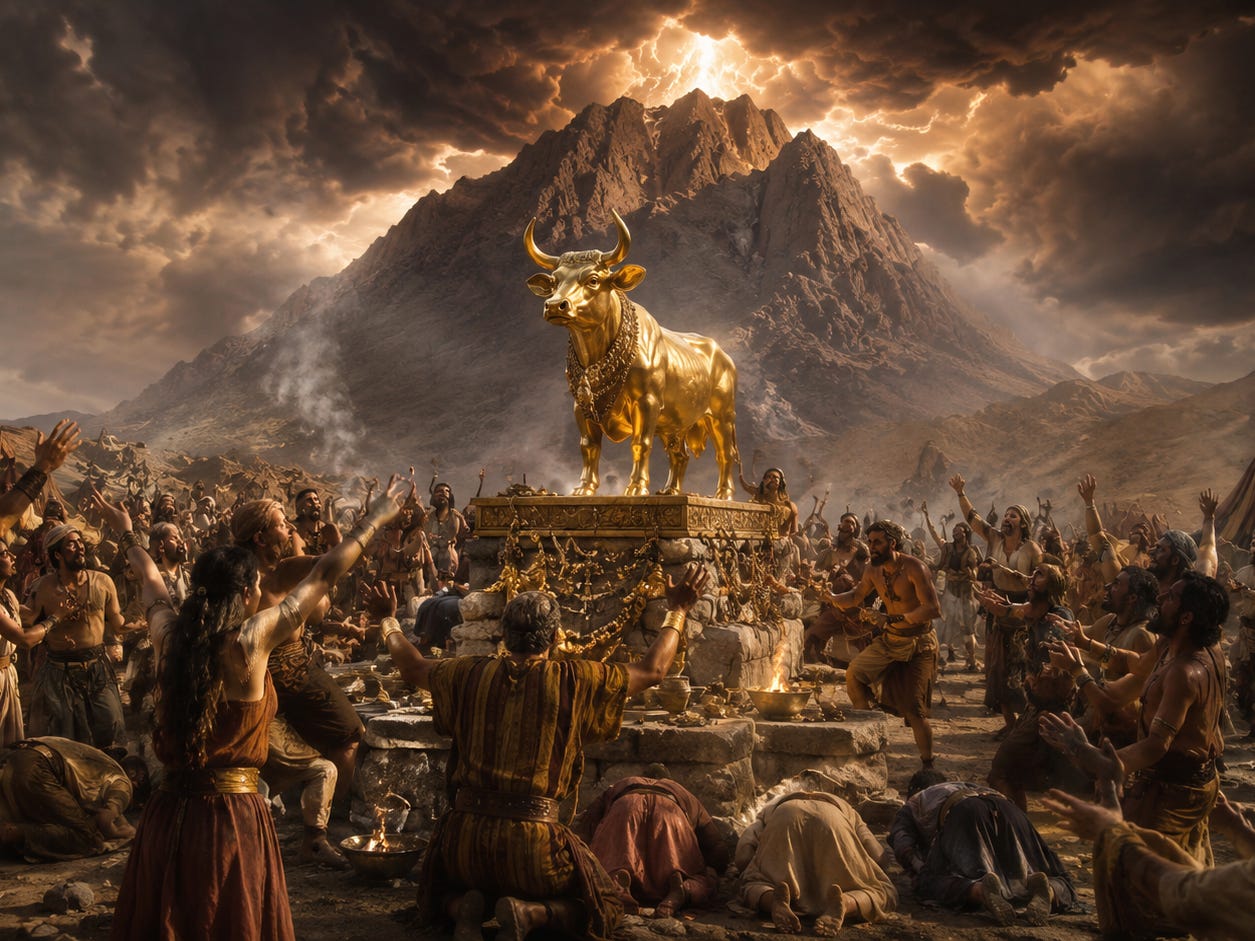
Eikev also returns to one of Israel’s greatest failures: the Golden Calf. Moses recalls ascending Mount Sinai, receiving the tablets, discovering the people’s betrayal and smashing the tablets — but the story does not end with destruction. God tells Moses to return. There will be another set. There is a subtle difference between the two.
The first tablets are described in Exodus as “the work of God.” After they are shattered, Moses is told to carve the second set himself. The words will still come from God. But this time Moses has to prepare the stone. There is an extraordinary lesson hidden inside that distinction: The first covenant arrives as a miracle, the repaired covenant requires human participation.
That is often how life works.
The first version of something can feel effortless: a friendship, a marriage, a community, a dream, a relationship with Judaism. Then something breaks, and we become obsessed with getting back what existed before. But perhaps the goal is not always restoration; sometimes the second tablets must be different from the first. Sometimes what comes after failure requires more work from us, and becomes more precious precisely because of that work.
Jewish history itself can almost be read this way: Temples were destroyed, communities were expelled, languages disappeared, entire centers of Jewish civilization were annihilated — and again and again, Jews carved new tablets. Yavneh, Babylon, Spain, Poland, Morocco, Baghdad, the modern West, Israel.
The forms changed. The covenant continued. Judaism does not teach us that nothing will break. It teaches us that brokenness does not get the final word.
Near the end of Eikev, Moses makes an interesting comparison between Egypt and Israel. Egyptian agriculture depended heavily on the Nile and irrigation. The Land of Israel, Moses explained, depends upon rain from heaven. On the surface, that sounds like an agricultural observation. Spiritually, it is much more.
Egypt represents predictability: The river is there, water can be controlled, and systems can be engineered. Israel requires looking upward — waiting, hoping, recognizing limits.
Modern people are naturally drawn toward Egypt in this sense. We want dashboards, forecasts, metrics, insurance, calendars, algorithms, and five-year plans. We want enough information to eliminate uncertainty. And these things are useful. Judaism is not opposed to planning.
But Eikev reminds us that no sufficiently sophisticated system can eliminate vulnerability from human life. You can exercise and still become sick. You can save money and still experience financial trouble. You can choose someone carefully and still have your heart broken. You can raise children lovingly and still be unable to determine who they become. You can build the strongest army in a region and still require vigilance tomorrow.
Eventually every human being discovers that there are things beyond his control. The question is whether that realization destroys us or humbles us. Faith is not the belief that everything will happen the way we want. Faith is the recognition that we were never promised complete control in the first place.
After recounting Israel’s mistakes, Moses asks one of the Torah’s great questions: “What does God ask of you?” The answer is surprisingly simple: to walk in God’s ways, to love, to serve, to observe. And only a few verses later, Moses gives this spiritual program an ethical consequence: God loves the stranger, and therefore we must love the stranger as well.
This matters because Jewish identity can become narcissistic if we are not careful. We can become so focused on preserving ourselves that we forget what Judaism is asking us to become. The Torah does not ask Jews merely to survive as Jews. It asks us to behave like Jews. There is a difference. Jewish survival is the prerequisite; Jewish purpose is the objective.
And Eikev offers some answers: Remember deliberately, practice gratitude especially when you feel entitled to gratitude least, pay attention to the small mitzvot, do not confuse achievement with self-creation, teach Jewish history before a crisis forces your children to ask about it, build Jewish homes that contain more celebration than fear, accept that some things remain beyond your control, turn failure into responsibility rather than despair, and never allow Jewish identity to become merely the scar tissue left behind by antisemitism.
The Jews standing before Moses had already learned how to survive the wilderness. The challenge now was harder: They had to learn how to live in the land. That may be Eikev’s most enduring lesson. Survival is not the final Jewish objective. The purpose of surviving is to build a Jewish life worth surviving for.
This is so beautiful. Thank you!
Thank you for this much needed education. It is sad that, despite having gone to Hebrew school, been a bat mitzvah and then being confirmed, my knowledge of Judaism is pitiful. I hope you will keep doing pieces like this.