


Please consider supporting our mission to help everyone better understand and become smarter about the Jewish world. A gift of any amount helps keep our platform free of advertising and accessible to all.
You can also listen to the podcast version of this essay on Apple Podcasts, YouTube Music, YouTube, and Spotify.
The first thing Jews should remember about ancient Egypt is that it did not begin with slavery.
It began with success.
Joseph rose to become one of the most powerful men in Egypt. His family was welcomed. Pharaoh gave them land. The Israelites settled in Goshen, built lives, raised families, accumulated possessions, and flourished. The Torah says they “were fruitful and prolific; they multiplied and increased very greatly.”
Egypt was good to the Jews — until it wasn’t. Then came perhaps one of the most consequential sentences in Jewish history: “A new king arose over Egypt who did not know Joseph.”
Suddenly, the very things that had once demonstrated the Israelites’ successful integration into Egypt became evidence against them. They were numerous. They were prosperous. They were different. They were powerful enough to be feared.
Pharaoh tells his people, “The Israelite people are much too numerous for us.” And the story changes. Prosperity becomes suspicion. Difference becomes danger. Success becomes power. Power becomes conspiracy. And eventually, the society that had allowed the Jews to flourish decided that Jewish flourishing itself was a problem.
I have been thinking about that story a lot lately because I increasingly wonder whether the West is entering its own Egypt. I do not mean that Jews in America, Britain, Canada, France, or elsewhere are about to become slaves. We are not living in ancient Egypt. Western democracies still afford Jews extraordinary freedoms, protections, opportunities, and political power.
Historical analogies become ignorant when they require history to repeat itself literally. But Jewish history teaches us to recognize direction before destination, and the current direction should concern us.
For much of the last several centuries, the modern West represented something extraordinary in Jewish history. We were emancipated. We were admitted into universities, professions, governments, cultural institutions, businesses, neighborhoods, and social circles from which Jews had once been excluded. And we prospered, spectacularly.
Jewish prosperity in the West may be one of the great success stories in the history of the diaspora. Jews became scientists and physicians, entrepreneurs and professors, writers and filmmakers, lawyers and judges, philanthropists and politicians. We did what minorities are supposedly encouraged to do: We worked, studied, built and contributed to institutions, integrated without completely assimilating, and generally contributed enormously to the societies around us.
And because liberalism promised that citizens would be judged as individuals rather than as representatives of tribes, Jews embraced the liberal West with extraordinary enthusiasm.
But something in the West has begun to change: The new Pharaoh is not a person. It is an idea. The idea is that society should no longer understand people principally as individuals but as members of groups arranged according to power: “oppressor” and “oppressed,” “colonizer” and “colonized,” “privileged” and “marginalized,” “white” and “non-white,” successful and unsuccessful.
The problem for Jews is obvious: We break the system. We are one of history’s most persecuted minorities and one of the modern West’s most successful minorities. We have experienced exile, massacre, expulsion, forced conversion, ghettos, pogroms, dispossession, and genocide. And then we succeeded anyway.
That should be regarded as an inspiring story. Increasingly, however, Jewish success is being used to disqualify Jews from liberal categories. In a political culture that sometimes treats unequal outcomes as evidence of injustice, the successful minority becomes difficult to explain. And so its success gets reinterpreted as privilege, power, whiteness, influence, or colonialism.
The vocabulary changes, but the underlying danger is ancient. Once again, Jewish success is being turned into an argument against Jewish innocence.
There are certainly electoral and coalition pressures at work. Muslim and Arab communities have become increasingly important political constituencies in parts of the United States, Canada, and Europe.
The deeper exchange has been ideological: Parts of the Left have traded universal minority rights for a hierarchy of minorities. Under the old liberal model, antisemitism was wrong because prejudice was wrong. Racism was wrong because prejudice was wrong. The identity of the perpetrator and the perceived social status of the victim did not determine the moral character of the act.
But grievance politics works differently. It asks: Who has power? Who has privilege? Who is indigenous? Who is colonial? Who ranks higher in the hierarchy of historical suffering?
And in that framework, Jews have an enormous problem: We became successful. Worse still, we became sovereign. Israel may be the greatest disruption of the modern victimhood hierarchy imaginable. And suddenly the Jew no longer looked like the kind of minority some Westerners had learned to recognize.
The Jew now has a gun and an air force. The Jew could fight back. The Jew could win. And apparently, winning changes everything.
This is one reason the Jewish experience after October 7th was so psychologically revealing. On October 7th, Jews experienced the deadliest day for our people since the Holocaust. And almost immediately, before Israelis had even buried their dead, portions of the Western world began explaining what the Jews had done to deserve it.
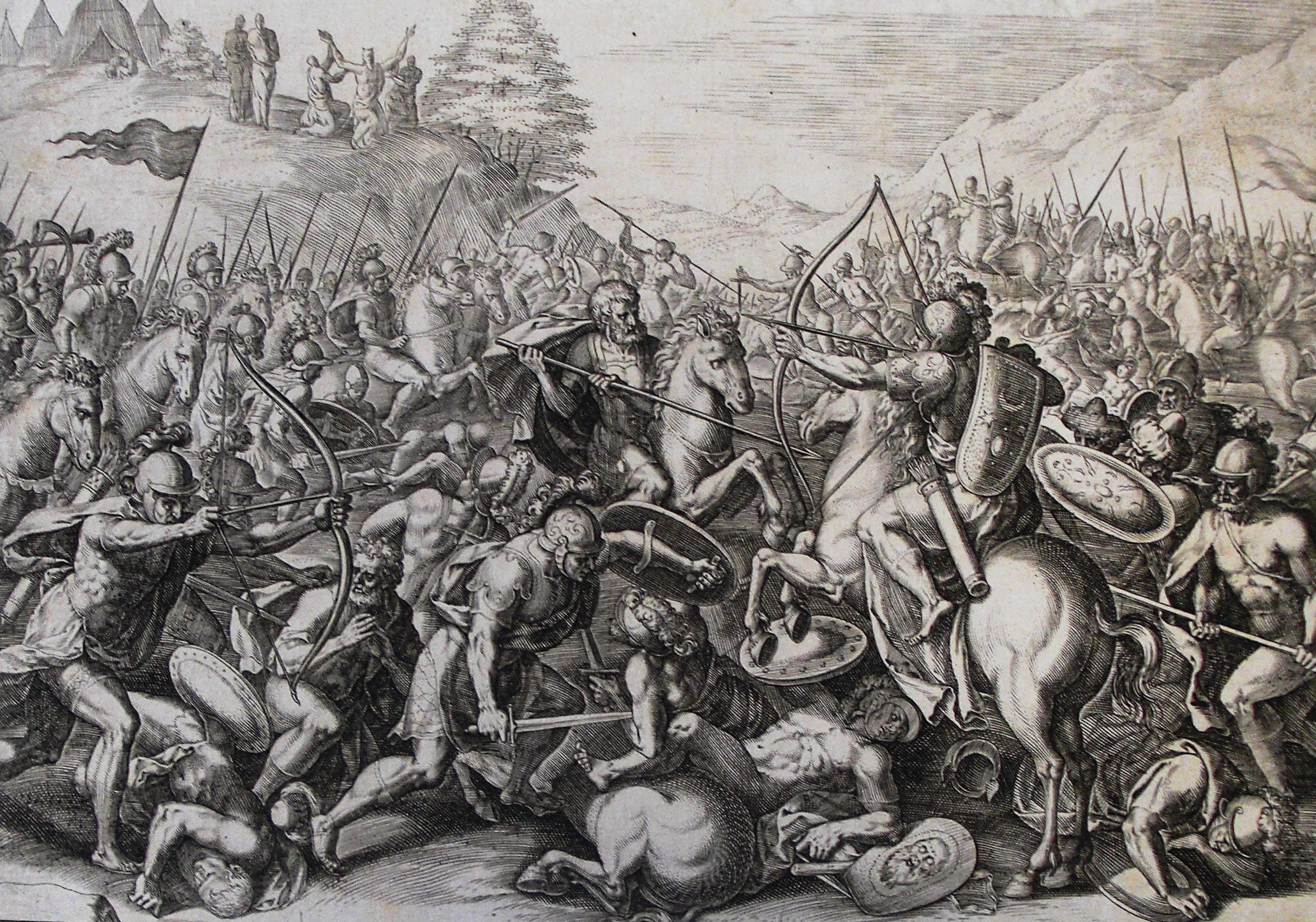
The reaction was so fast that, for many Jews, it created something even more dangerous: doubt. And that brings us to Amalek, a grandson of Esau. After the Israelites escape Egypt, another enemy appears: Amalek, who launched a surprise attack on the Israelites at Rephidim near Mount Sinai shortly after the Exodus from Egypt.
The Torah does not merely say Amalek attacked the Israelites. It tells us how: “Remember what Amalek did to you on your journey, after you left Egypt,” Deuteronomy commands. Amalek attacked from behind. He struck the stragglers, the weak, the exhausted, those struggling to keep up. Amalek searched for vulnerability.
That is why Amalek occupies such a unique place in Jewish memory.
There are countless nations that fought ancient Israel. We are not commanded to remember all of them forever. But Amalek represents something more than ordinary warfare: Amalek attacks Jewish weakness.
And Jewish tradition adds another astonishing layer: The Hebrew word Amalek — עמלק — has the numerical value 240. So does the Hebrew word safek — ספק — which means doubt.
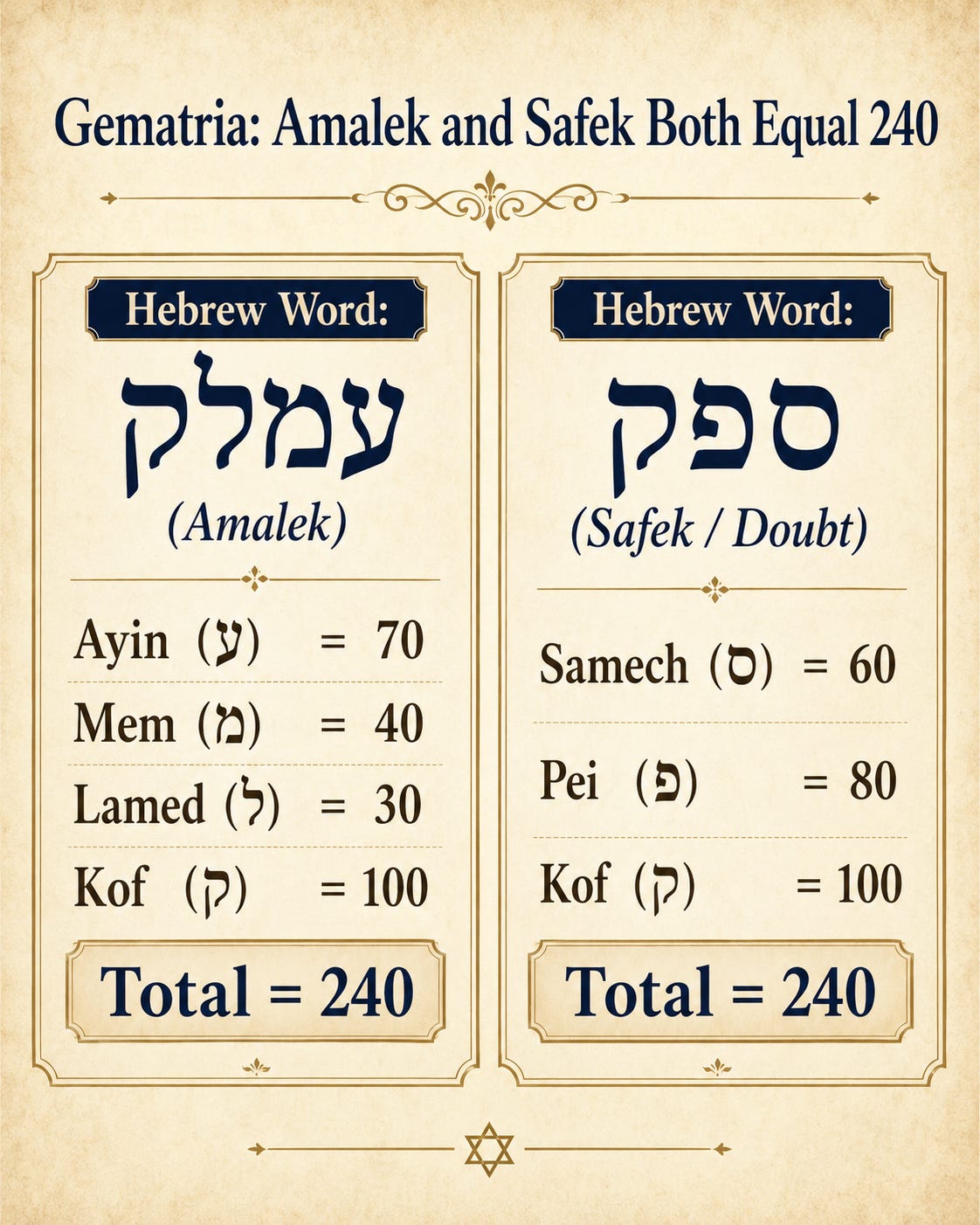
Amalek, in one famous Jewish interpretation, is the force of doubt. It does not merely attack Jews physically. It gets inside the Jewish mind. It compels Jews to say: Maybe we are wrong, maybe they are right about us, maybe Israel really is uniquely evil, maybe Zionism really is shameful, maybe our enemies hate us because of something we have done, maybe if we dissociate ourselves from Israel they will leave us alone, maybe if we become the good Jews they will accept us.
That is Amalek’s greatest victory: not killing Jews, but confusing them.
October 7th created Jewish vulnerability on a scale our generation had never experienced. And precisely at that moment, parts of the West went after the stragglers: students suddenly afraid to wear a Star of David, Jews wondering whether to remove mezuzot, employees reluctant to mention Israel at work, Jewish organizations requiring greater security, Zionist students discovering that belonging to certain “progressive” spaces increasingly required explaining, apologizing for, or renouncing a fundamental part of their Jewish identity.
Something particularly painful has happened on portions of the Western Left because Jews thought that was where the principles protecting us lived. We believed people who spoke incessantly about minorities would recognize a minority when Jews were attacked. We believed people who warned about hateful rhetoric would recognize hateful rhetoric when Jews were its target.
We believed people obsessed with trauma would understand Jewish trauma. We believed people who said victims should be believed would believe Jewish victims. We believed people who condemned collective punishment would reject holding Jewish students in Melbourne, London, or Los Angeles responsible for decisions made by an Israeli government thousands of miles away.
Instead, many Jews discovered an exception: us. That is what makes this moment feel Egyptian.
Egypt did not suddenly discover that the Israelites were different. Egypt had always known. What changed was the interpretation of the difference. The same Israelites who had once contributed to Egypt’s prosperity became a population to fear. The blessing became the threat. Today, that is the danger facing Jews in the West.
The successful Jew becomes suspicious precisely because he is successful. The sovereign Jew becomes immoral precisely because he is sovereign. Jewish achievement becomes privilege. Jewish solidarity becomes tribalism. Jewish self-defense becomes aggression. Jewish nationalism becomes racism. Jewish historical attachment to Israel becomes colonialism.
And eventually Jewish vulnerability becomes invisible because the political framework has decided beforehand that Jews possess too much power to truly be vulnerable.
Antisemitism has always been unusual among prejudices. Most hatreds describe their target as inferior. Antisemitism frequently describes Jews as superior — too rich, too influential, too organized, too connected, too powerful. That means a political culture obsessed with locating hidden structures of privilege can stumble surprisingly easily into ancient antisemitic ideas while believing itself to be fighting prejudice.
The language may be modern. The architecture is very old.
And Jews must be careful about how we respond. Our first responsibility is not to convince ourselves that another Holocaust is around the corner. Panic is another form of historical illiteracy. America is not Nazi Germany. Britain is not the Soviet Union. France is not medieval Spain. And the West is not literally Egypt.
Our responsibility is something harder: to remain awake.
Jewish history teaches that civilizations do not send invitations announcing that the golden age has ended. The change happens culturally before it happens politically. Things that once could not be said become jokes, then arguments, then slogans, then fashionable opinions, then institutional positions.
The social cost of hating Jews declines. The social cost of defending Jews rises. And somewhere along the way, Jews begin adjusting. That adjustment is where Amalek enters. We hide the necklace. We stop mentioning Israel. We remove the Israeli flag. We qualify the word Zionist.
We say, “Of course I oppose Netanyahu,” before anyone has even asked. We rush to establish that we are not those Jews. We desperately demonstrate that we understand Palestinian suffering before we permit ourselves to speak about our own. We begin negotiating with people who have already decided that Jewish self-determination itself is immoral.
And eventually we can become so obsessed with proving that we are acceptable Jews that we forget to ask whether the people demanding the proof are acceptable to us.
That is safek — doubt. And it may be the most important reason Torah commands us to remember Amalek.
The opposite of Amalek is not merely military strength. It is certainty. The certainty Judaism demands is more fundamental: We are allowed to exist, we are allowed to defend ourselves, we are allowed to succeed, we are allowed to possess power, we are allowed to love our people, we are allowed to love our homeland Israel, we are allowed to believe our own history, and we do not require permission from anyone else to remain Jews.
There is another reason the Egypt story matters: Egypt is not where Jewish history ends. Egypt is where Exodus begins. The Jewish response to Pharaoh was ultimately not to convince Pharaoh that Jews posed no threat. It was not to become less Jewish. It was not to apologize for multiplying. It was not to demonstrate that we deserved Egypt.
God tells Moses something much simpler: Leave, become a people, walk into history. That is the great Jewish lesson of Egypt: Our security cannot ultimately rest upon whether another civilization happens to approve of us at a particular moment.
For generations, Western Jews understandably believed we had finally escaped that historical condition. Perhaps we had. Perhaps we still have. But October 7th should at least have reminded us that Jewish history did not end when Jews entered Harvard, Hollywood, Parliament, Congress, or the pages of The New York Times.
The ancient questions remain: Who are we when the society around us changes its mind about us? What happens when Jewish prosperity becomes evidence of Jewish privilege? What happens when Jewish power becomes evidence of Jewish guilt? What happens when the political movements we supported decide that we have been promoted from “oppressed” to “oppressor”? What happens when the price of acceptance becomes distancing ourselves from other Jews?
And what happens when Amalek whispers that perhaps we should?
We have heard that whisper before. The answer is the same as it has always been: Remember, remember Egypt, remember Amalek, and remember that our ancestors survived societies infinitely more hostile than ours because they refused to allow those societies to define what a Jew was.
The West may be entering a darker period for Jews. Perhaps it will correct itself. I hope it does. Liberal democracy remains one of the greatest friends the Jewish People have ever had, and it is worth defending fiercely.
But Jews should never confuse gratitude with dependence. Egypt was once good to us too; the Torah still told us to leave, because prosperity was never the source of Jewish existence.
We were Jews before Egypt welcomed us. We were Jews after Egypt enslaved us. We were Jews when the West excluded us. We were Jews when the West embraced us. And if parts of the West now decide that Jewish success is suspicious, Jewish sovereignty is sinful, and Jewish self-defense disqualifies us from sympathy, we will remain Jews after that too.
The greatest danger is not that the West will doubt the Jews. It always has. The greatest danger is that the Jews will begin to doubt themselves. That is Amalek. And that is the battle we cannot afford to lose.
This is an exquisitely argued case. I will keep this in my folder, perhaps forever. It's worth keeping.
I believe we are facing a looming catastrophe. I don't know what shape it will take, but I believe it will be worse than anything we have ever faced in our history in one unique way, and that is its global nature.
You say not to panic and believe a Holocaust is around the corner. Probably not. But something is around the corner. I can't recall a time in Jewish history when social unrest coupled with rising antisemitism ever turned out well for us, so I'm not optimistic.
We are considering for the first time making aliyah, because although Jews face other sorts of dangers in Israel, at least there we can be openly and proudly Jewish. I feel a strong sense of no longer belonging here (writing from the United States).
I am not ethically Jewish, however I have been a Zionist since my teen years. It occurs to me that one of the best things Jews could do to ensure their future is to stop voting against their own interest, which is to say stop voting Democrat. Their entire power base is predicated on envy, and what easier target than those who have struggled and done well?