


Please consider supporting our mission to help everyone better understand and become smarter about the Jewish world. A gift of any amount helps keep our platform free of advertising and accessible to all.
This is a guest essay by Avraham Russell Shalev, a Senior Fellow at the Kohelet Policy Forum, a Jerusalem-based research institute.
You can also listen to the podcast version of this essay on Apple Podcasts, YouTube Music, YouTube, and Spotify.
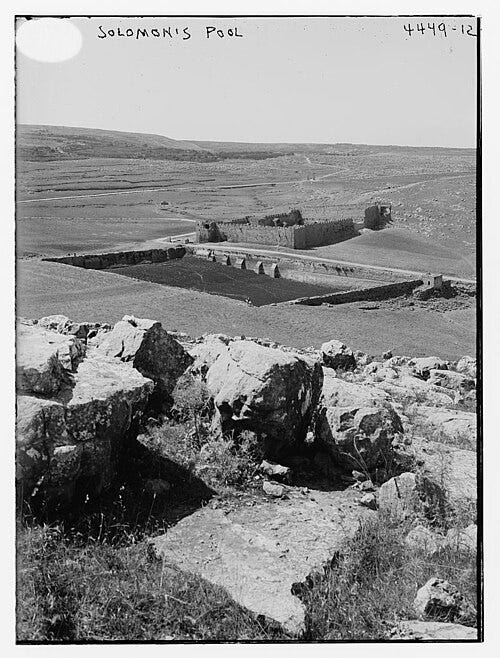
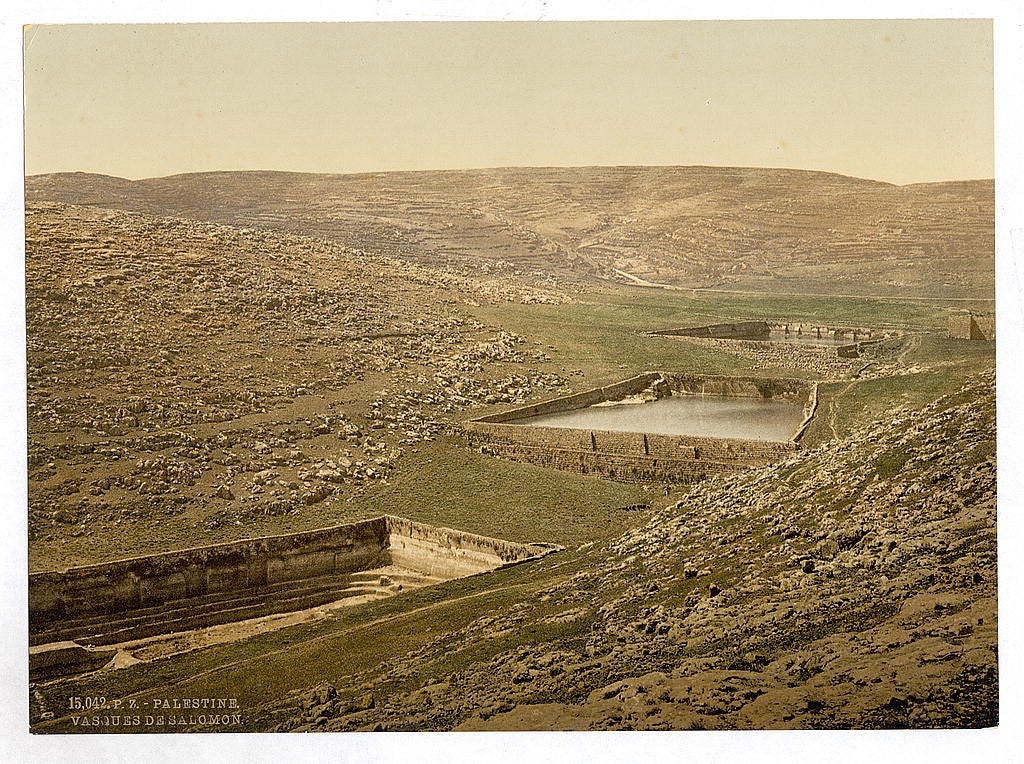
According to reports, the Palestinian Authority plans to build a mosque on the site of Solomon’s Pools, an ancient archaeological complex located four kilometers (approximately 2.5 miles) south of Bethlehem.1
The proposed construction cannot be understood as an ordinary development dispute. Solomon’s Pools are part of the ancient landscape of Jewish Jerusalem. They are mentioned in “Antiquities of the Jews” by Josephus Flavius, the Roman–Jewish historian who wrote that King Solomon visited the site.
Archaeologists generally believe that the pools were constructed during the Hasmonean period, between 140 and 37 BCE, or the Herodian period, between 37 BCE and 70 CE, when the growing number of pilgrims traveling to the Temple in Jerusalem required greater access to water.
The site therefore represents more than an isolated archaeological curiosity. It is part of the physical infrastructure that supported Jewish religious life in ancient Jerusalem.
That is precisely why the Palestinian Authority’s apparent plans for the site must be viewed within a much larger ideological campaign.
The Palestinian Authority, like much of the Palestinian national movement, does not merely challenge modern Israeli sovereignty. It systematically denies the historical relationship between the Jewish People and the Land of Israel. Archaeological sites that testify to Jewish antiquity are therefore not treated as shared cultural resources worthy of preservation. They are treated as obstacles to the Palestinian political narrative.
The destruction, neglect, appropriation, and reclassification of Jewish archaeological sites are not random or disconnected acts. They are the physical expression of an ideology that first denies Jewish history and then attempts to remove its evidence from the landscape.
This denial is embedded in the foundational documents of the Palestinian national movement. Article 18 of the Palestinian National Charter rejects the historic and spiritual ties between Jews and Palestine, denies that Jews constitute a people with an independent national identity, and reduces Judaism to a religion practiced by citizens of other countries.
The argument is unmistakable: Jews are not a nation, Jewish history in the land is fabricated, and Jewish sovereignty is therefore inherently illegitimate.
Palestinian leaders have repeated variations of this claim for decades.
Mahmoud Al-Habbash, the Palestinian Authority chairman’s adviser on religious affairs and Islamic relations, has described Jewish history in the land as a collection of lies and inventions designed to justify occupation and theft. In his telling, Israel did not merely seize geography; it fabricated an entire historical narrative to complete its takeover of Palestinian territory.
Al-Habbash has similarly denied that the Jewish People ever maintained a Temple, political presence, or sovereignty on the Temple Mount. His broader message is that Israelis have no historical connection to the land and that, if anyone must leave, it should be the Jewish population he characterizes as a foreign occupying force.
Palestinian Authority Chairman Mahmoud Abbas has promoted the same historical revisionism. He has repeated the false claim that the ancient Jewish temples were located in Yemen rather than Jerusalem. He has also argued that modern Jews are not descendants of the ancient Israelites but of the Khazars, a medieval people whose ruling class converted to Judaism.
This theory is not presented as an obscure historical possibility. It functions as a political weapon. By separating modern Jews from the ancient Jewish People, Palestinian leaders attempt to sever the connection between living Jews and the archaeological evidence beneath their feet.
The same message has been institutionalized through official conferences, universities, state media, religious authorities, and senior political offices.
At a conference hosted by Abbas at Al-Quds Open University, speakers gathered for the explicit purpose of refuting what they called the Zionist narrative. Palestinian Authority Prime Minister Muhammad Shtayyeh and other participants repeated the Khazar theory and disputed the existence of any meaningful connection between modern Jews and the Land of Israel.
Shtayyeh later claimed that Israel had falsified Palestinian history and that decades of archaeological excavations since 1967 had failed to demonstrate any direct or indirect Jewish connection to the land. Abbas’ spokesman, Nabil Abu Rudeina, advanced the same argument on official Palestinian Authority television, maintaining that archaeology had produced no proof of a historical Jewish presence.
The repetition matters. These statements are not isolated rhetorical excesses from fringe activists. They form a coherent doctrine articulated by the Palestinian Authority’s chairman, prime minister, presidential advisers, spokesmen, religious authorities, educational institutions, and official media.
The doctrine begins with historical denial. It insists that there was no Temple, no Jewish sovereignty, no continuous Jewish People, and no legitimate connection between modern Jews and ancient Israel.
The physical consequences follow naturally. Once Jewish history is dismissed as an invented political narrative, Jewish archaeological sites no longer need to be preserved as evidence of an ancient civilization. They can be neglected, repurposed, built over, renamed, or absorbed into an exclusively Palestinian or Islamic historical narrative.
The proposed construction at Solomon’s Pools must therefore be understood not merely as construction on an archaeological site, but as the continuation of a campaign to transform the physical record of Jewish history.
It is also a direct challenge to the Palestinian Authority’s legal obligations.
Under the 1995 Israeli-Palestinian Interim Agreement, commonly known as Oslo2 II, the Palestinian side is required to protect and safeguard archaeological sites, prevent damage to them, and take precautionary measures when carrying out activities that may affect them.
The obligation is straightforward. Archaeological sites under Palestinian control are not political props to be reshaped according to ideological preference. They are cultural resources that the Palestinian Authority formally agreed to preserve.
An assault on Solomon’s Pools would therefore represent more than a violation of the spirit of Oslo. It would constitute a breach of an explicit Palestinian commitment to protect archaeological heritage.
The legal implications extend beyond Oslo.
International criminal law has increasingly recognized that the deliberate destruction of cultural and religious property can represent something far more serious than ordinary property damage. When sacred sites are targeted because they embody the history, religion, or identity of a particular people, the destruction becomes an attack on the people themselves.
At the Nuremberg Trials, the International Military Tribunal treated the systematic Nazi destruction of synagogues as an act of persecution and therefore as part of a broader crime against humanity. The significance of the destruction did not lie only in the physical loss of buildings. Synagogues represented Jewish religious life, communal continuity, and collective identity. Their destruction was one component of the attempt to eradicate the Jewish presence from Europe.
The International Criminal Tribunal for the Former Yugoslavia later developed this principle further.
The tribunal recognized that the deliberate destruction of religious institutions can constitute persecution when carried out with discriminatory intent. Cultural heritage, in this understanding, is not merely a collection of buildings and objects. It is the physical embodiment of a people’s history, memory, religion, and identity.
To destroy that heritage intentionally is to attack the community to which it belongs.
In the Kordić case, the tribunal concluded that the destruction of mosques without military justification — including culturally and religiously significant sites in Ahmići — helped demonstrate an intent to destroy the local Bosnian Muslim community. In the Krstić case, attacks on religious property were similarly treated as evidence of a broader intent to eliminate a group.
These decisions helped solidify an essential principle of customary international law: the deliberate destruction of cultural and religious heritage may be criminal when it is used as an instrument of persecution.
The tribunal also recognized the connection between cultural destruction and genocide. Physical or biological attacks against a group are frequently accompanied by attacks on its religious sites, cultural symbols, homes, archives, and institutions.
Cultural destruction does not by itself necessarily constitute physical genocide. It can, however, provide powerful evidence of genocidal intent. A movement seeking to eliminate a people will often attempt to eliminate the visible proof that the people ever existed.
It destroys their houses of worship. It removes their inscriptions. It renames their cities. It rewrites their history. It appropriates their sacred places. It replaces the archaeological record with a politically acceptable narrative.
The campaign against cultural heritage is therefore not separate from a campaign against human beings. It is frequently one of its earliest and most revealing expressions.
This legal principle was applied directly by the International Criminal Court in 2016, when it sentenced Ahmad al-Faqi al-Mahdi, a member of an extremist group affiliated with al-Qaeda, to nine years in prison for intentionally directing attacks against ten historic and religious structures in Timbuktu, Mali, during the summer of 2012.
The court acknowledged that crimes against property are generally considered less severe than crimes committed directly against persons. Yet it found that the destruction in Timbuktu possessed exceptional gravity because the targeted buildings were not ordinary property.
The mosques and mausoleums were foundational to the religious identity, collective memory, and social cohesion of the local population. They possessed deep emotional and symbolic meaning for the people of Timbuktu. Nine of the ten structures were also UNESCO World Heritage sites, making their destruction an offense against the cultural inheritance of the international community.
The court’s reasoning was important because it recognized that the value of a sacred or historical site cannot be measured only in stone, timber, or monetary loss.
A religious monument can hold the memory of generations. An archaeological site can preserve the history of an entire civilization. Once destroyed, it cannot simply be replaced with another building.
The protection of such sites has therefore risen beyond the boundaries of ordinary property law. It reflects a growing international consensus that an attack on the cultural heritage of a people is an attack on humanity’s shared inheritance.
The International Criminal Court also interpreted Article 8(2)(e)(iv) of the Rome Statute broadly, determining that the prohibition against attacking religious and historic objects is not necessarily limited to moments of active combat. Even after Al-Mahdi pleaded guilty, the court insisted on creating a comprehensive historical record of the crimes. That record was necessary not only to establish criminal responsibility, but also to protect Mali’s collective memory and contribute to cultural reconciliation.
The lesson is clear: Cultural erasure is not a secondary concern to be addressed only after political or military disputes are resolved. It is often part of the conflict itself. That is what makes the proposed transformation of Solomon’s Pools so serious.
The site exists within an environment in which senior Palestinian officials repeatedly deny that Jews have any history in the land. Those same political institutions are responsible for protecting the archaeological evidence that disproves their narrative.
This is an obvious and dangerous conflict. The Palestinian Authority cannot be expected to safeguard Jewish heritage faithfully while its leaders insist that Jewish heritage is fraudulent. It cannot serve as a neutral custodian of archaeological sites while its political legitimacy rests partly on denying the civilization those sites represent.
A government that teaches its population that ancient Jewish history is an invention will inevitably treat physical evidence of that history as something to be neutralized.
The organized destruction and appropriation of Jewish cultural heritage across the Land of Israel must therefore be understood as a deliberate policy of identity erasure rather than a collection of random acts of vandalism.
Historical revisionism and physical destruction are not separate phenomena. They are two stages of the same campaign. First, Jewish history is denied. Then the archaeological evidence is neglected, damaged, covered, renamed, or repurposed. Finally, the altered site is presented as proof that the Jewish connection never existed.
Taken together, the Palestinian Authority’s official rhetoric and the repeated violations of Jewish heritage sites throughout Judea and Samaria establish a clear pattern of cultural persecution. Under the principles developed at Nuremberg, by the International Criminal Tribunal for the Former Yugoslavia, and by the International Criminal Court, the intentional destruction of a community’s spiritual and cultural inheritance can represent a crime against humanity and evidence of an underlying effort to erase that community’s collective identity.
Solomon’s Pools are not merely three ancient reservoirs outside Bethlehem. They are part of the physical record of Jewish civilization in the Land of Israel. They testify to the infrastructure, pilgrimage, worship, and communal life that connected ancient Jerusalem to its surrounding landscape.
Building over, altering, or appropriating such a site would not simply damage old stones. It would advance a political narrative that depends on stripping the Jewish People of their past.
The Palestinian Authority has formally accepted responsibility for protecting archaeological resources under its control. International institutions also claim to defend cultural heritage as part of the inheritance of humanity. Yet both have repeatedly failed to prevent the destruction, neglect, and appropriation of Jewish sites.
When the authorities entrusted with protecting cultural heritage instead deny the history that heritage represents, responsibility cannot be left to declarations, resolutions, and unenforced agreements. The legal and ethical mandate to preserve these sites rests increasingly with Israel.
Protecting Solomon’s Pools and similar archaeological sites is not an act of political expansion. It is an act of historical preservation. It is the defense of evidence against an organized campaign of denial.
The ancient architectural and archaeological layers of the Land of Israel belong not only to the Jewish People, but to the historical record of humanity. Preserving them is therefore not optional.
It is an immediate imperative for defending historical truth against those determined to erase it.
“Obliterating History: The Systematic Campaign to Erase Jewish Ties to the Land of Israel.” Kohelet. July 2026.
The Oslo Accords are a pair of foundational agreements between Israel and the Palestine Liberation Organization (PLO) signed in 1993 (Oslo I) and 1995 (Oslo II).

The Palestinians tried this on the Temple Mount. This is just the latest example of the Palestinians’ violation of the Oslo Accords and the lack of accountability for doing so. For the Palestinians, Oslo is a diplomatic shield to entrench their jihadist ideology and continue their forever war against Israel. A “cold” war against Jewish identity and history is still a war, and the Israeli government must respond accordingly to protect Solomon’s Pools and other Jewish archaeological sites.
The historical fictional reading of “The Haj” by The late Leon Uris, author of the Exodus, gives great insights to the cultural (and possibly the biological) mind of Arab attitudes, aims and their rules of negotiation which are diametrically opposite of Westerners. With us, a deal is a deal, backed by good faith and our laws. With them, and you can throw in the Iranians, all this is fluid and subject to their overriding jihadism.