


Please consider supporting our mission to help everyone better understand and become smarter about the Jewish world. A gift of any amount helps keep our platform free of advertising and accessible to all.
This is a guest essay by Zineb Riboua, a research fellow for the Hudson Institute's Center for Peace and Security in the Middle East.
You can also listen to the podcast version of this essay on Apple Podcasts, YouTube Music, YouTube, and Spotify.
Many people forget that Iran entered the conflict against the U.S. and Israel carrying the most severe economic crisis in the history of the Islamic Republic.
President Masoud Pezeshkian had already warned that the country’s infrastructure was nearing the edge in July 2025. “In Tehran, if we cannot manage and people do not cooperate in controlling consumption,” he said in a speech in the Western city of Zanjan, “there won’t be any water in reservoirs by September or October.” 1
The damage today runs well beyond water management and is visible across three dimensions: the Iranian currency (the rial), the labor market, and the industrial base.
The rial’s collapse to 1.45 million per dollar in January triggered massive unrest, and the currency has since deteriorated further, now trading at around 1.87 million per dollar. Iran’s central bank issued a public warning, cautioning citizens against buying foreign currency, suggesting prices could reverse with intervention.
The Central Bank of the Islamic Republic of Iran said: “If expectations are adjusted, supply increases or the central bank makes targeted intervention, there is a possibility that prices will return and buyers at high rates will suffer losses.” A central bank warning its own population against holding dollars signals that the state has lost one of the most basic functions of monetary governance.
Moreover, the labor picture compounds the monetary one. The Iranian Deputy Minister of Cooperatives, Labor, and Social Welfare admitted last month that the war had directly destroyed over 1 million jobs, with 2 million additional losses due to different and indirect factors.
However, the government’s own officials cannot agree on the scale of the damage. Or perhaps they do not want to admit that U.S. and Israeli strikes have hit strategic assets. Indeed, some of them cited Social Security data suggesting that only 100,000 unemployment insurance cases may be added. Labor Minister Ahmad Meydari released another figure that 150,000 Iranians have recently registered for unemployment benefits.
What is striking is that each figure comes from a different ministry, is measured through a different methodology, and serves a different political purpose. More than anything else, it reveals a government far more concerned with managing the perception of unemployment than with addressing the problem itself.
“In the past year, Iran’s working-age population expanded by roughly 825,000 people, yet only 57,000 new jobs were created,” according to an article published in the Financial Tribune 10 days ago.2
Underlying both is the damage to Iran’s industrial base.
According to Iran International, the company Mobarakeh Steel — the largest steel producer in the Middle East and Northern Africa, and one of the largest industrial complexes operating in Iran — took direct and heavy hits. More than 27,000 workers have since been left without a clear employment status. Skilled technical staff who previously took home the equivalent of roughly $568 USD a month now earn close to the statutory floor, a reduction to roughly a fifth of former wages.
The problem that runs through everything else is that Iranian steel manufacturing depends on petrochemical feedstocks and energy inputs, while the petrochemical sector relies on domestic steel for plant construction and upkeep. These two industries function practically as a single interconnected system, and what made U.S. attacks lethal is how they struck at two of its load-bearing points.
This is also especially damaging for the Islamic Revolutionary Guard Corps (IRGC), since that system carries substantial weight in the Iranian economy, with petrochemicals generating approximately $13 billion in export revenue annually, ranking as the country’s second-largest source of foreign currency after crude oil.
Notably, drug prices have surged by as much as 400 percent; pharmacies report shortages across the country; and the internet shutdown that has long served as the regime’s preferred instrument for controlling the narrative may succeed in keeping Iranians from footage of IRGC battlefield failures, but it cannot keep them from a currency that has lost more than half its value.
In this sense, what the U.S.–Israeli operation has achieved so far is forcing the Islamic Republic to manage two fronts simultaneously, one facing outward toward protecting a mosaic military enterprise built on proxy funding, missile threats, and an unrelenting nuclear program, and one facing inward toward managing a population — that has shown repeatedly, at the cost of its own lives, that there is a threshold the regime keeps pushing past.
Alongside the strikes on key industries, the U.S. naval blockade has been severing export revenue at the source, with Kharg Island3 approaching storage capacity. Satellite imagery has captured a large oil slick west of the terminal, and the IRGC has been losing roughly $170 million a day. The Pentagon is placing total lost oil revenue at $4.8 billion to date.
Choking off oil exports, however, leaves untouched the financial network the Iranian regime built to process, move, and shelter that revenue through Chinese intermediaries, and that is precisely where the U.S.–Israeli collaboration operates.
Understanding it requires recognizing that previous rounds of sanctions fell short precisely because China absorbed Iran’s crude through teapot refineries, moved its funds through shadow banking networks, and supplied the IRGC with the intelligence infrastructure that kept its regional operations functional. The U.S.–Israeli operations go after all of it. As U.S. Secretary of the Treasury Scott Bessent put it: “We will relentlessly target the regime’s ability to generate, move, and repatriate funds, and pursue anyone enabling Tehran’s attempts to evade sanctions.”
U.S. President Donald Trump’s economic campaign runs on two levels.
The first level is about targeting the financial network through which Iranian oil moved outside the reach of Western regulators. The U.S. Department of the Treasury designated Hengli Petrochemical, China’s second-largest teapot refinery, roughly 40 shipping firms tied to Iran’s shadow fleet, and independently operated teapot refineries serving as the primary processors of sanctioned Iranian crude.
Beijing’s answer was a formal prohibition order directing Chinese citizens and companies not to comply, and the order itself was the tell: A government reduced to issuing emergency instructions to shield its firms from U.S. designations has run out of more discreet ways to do business with a state-sponsor of terrorism.
The second level is about converting economic pressure on the IRGC into a political-exposure campaign directed at China. The sanctions against Chinese companies like Meentropy Technology, The Earth Eye, and Chang Guang Satellite Technology for helping Iran track U.S. and allied military movements with satellite intelligence officially put China’s involvement in Iranian military operations on the public record, giving regulators a legal basis to expand action against Chinese satellite imaging companies.
Those watching the ceasefire negotiations and concluding that the conflict is winding down are misreading the situation in ways that carry real analytical consequence — because, while the strikes have paused, the U.S.–Israeli operations continue to function as both the accelerator and the anchor of what the military phase set in motion, converting battlefield destruction into institutional deterioration that compounds over time. Plus, the operations deny the IRGC the fiscal and organizational capacity to reconstitute what earlier military actions dismantled.
The IRGC likes to boast about its immunity to external pressure, but the economic situation reveals an organization that is disoriented, operating a model so rigid and so dependent on conditions that no longer exist. It has no productive response to the pressure now bearing down on it.
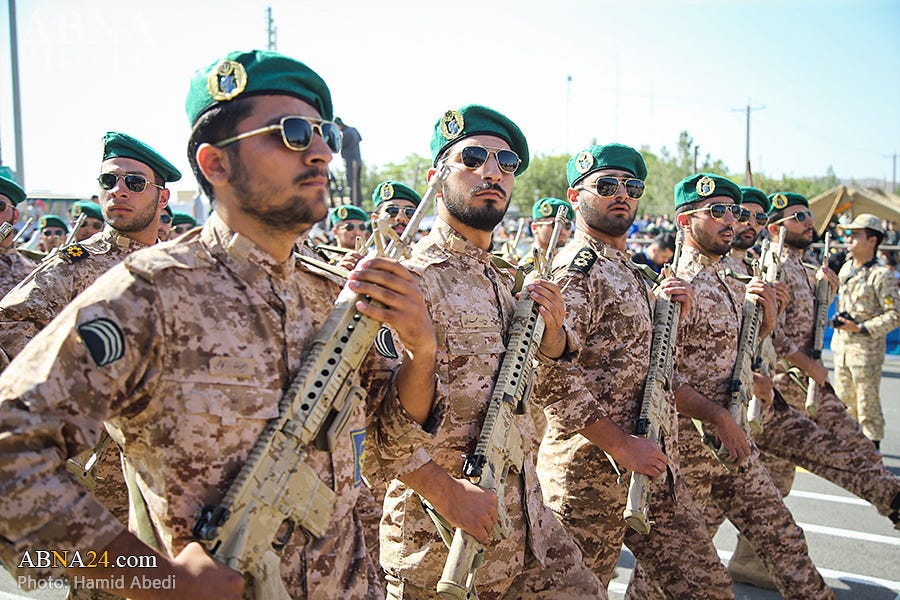
The Islamic Republic was never held together by ideology alone, nor by coercion alone. What sustained it more than anything and what made it so sophisticated was this sort of layered and cohesive system in which ideological commitment, selective repression, and material patronage reinforced one another, with each element compensating for the others when one weakened.
Hezbollah received an estimated $700 million annually. The Houthis in Yemen, the Popular Mobilization Forces in Iraq, Hamas and Palestinian Islamic Jihad in Gaza, and a range of other proxies all drew from the same source. Ideology may explain why men join a revolutionary movement, but it rarely explains why they stay, and it never explains why they fight consistently for a long period and in different domains and areas. That requires payment, logistics, and an Iranian regime capable of delivering on its end of the arrangement.
Across a region where state institutions had long proven predatory, inefficient, or simply absent, the IRGC offered what was genuinely scarce: an organization that paid on time, supplied its partners with functioning equipment, and followed through on its commitments. That operational reliability secured its regional influence as much as any ideological affinity, and the same principle sustained the regime’s domestic claim to institutional authority.
Authoritarian regimes can absorb significant popular pain, and the Islamic Republic has repeatedly demonstrated that capacity. Sustained endurance, however, rests on two conditions operating in concert. The first is a coercive apparatus possessing the organizational coherence and material resources to deploy force at scale. The second is a population that still calculates the cost of protest as exceeding the cost of compliance. Both conditions are now objectively in measurable decline.
The signs of erosion have already begun to surface at the institutional core. In March, members of Iran’s Special Units Command received notice that salary payments for certain units had encountered processing failures, the third such delay in wages for those forces within the year alone. The consequences were immediate, as some personnel refused to attend pro-government mobilization gatherings, causing visible disruptions to deployments in major cities. Retirees and segments of the regular army went unpaid for a second consecutive month.
At Bank Sepah (“Bank of the Army”), a major government-owned Iranian financial institution headquartered in Tehran, senior commanders have begun accusing the IRGC of exploiting the financial crisis to undermine the police force and consolidate resources toward bodies tied to the clerical establishment. What this pattern reveals is a military apparatus that, even with full awareness of a population pushed to its limits, has abandoned the collective management of scarcity and begun to redistribute it as a weapon among its constituent institutions.
The strategic environment has now narrowed the IRGC to two paths, each leading to a different form of institutional destruction. The beauty of the dilemma is that choosing either path only accelerates the collapse that the other path already threatens.
Path one is a deal with the United States. Accommodation with Washington would force the IRGC to surrender its network of construction contracts, import monopolies, and financial institutions that turned political power into wealth, and to do so in front of a population that has endured decades of falling wages, collapsing savings, and decaying infrastructure while national resources were poured into foreign conflicts.
Path two is continuing the war, but prolonged confrontation offers no escape either. It would push operational demands beyond the organization’s capacity, tighten sanctions that already cut off revenue streams, erode military credibility with each new engagement, and intensify internal rivalries among the clerical leadership, the IRGC, the bureaucracy, and the regular military as they fight over a shrinking pool of resources. A system built on patronage cannot survive once the patronage dries up.
The dilemma is structural, and no short-term fix can resolve it.
Every available path undermines the very conditions the organization needs to survive. This exposes the central contradiction of what the Islamic Republic constructed over four decades: a parallel military state within the state, a regional empire of proxies, and a financial system shielded from accountability, all built for outward projection of power — yet wholly unprepared for the mounting pressure now coming from both inside and outside.
“Tehran may run out of water before summer’s end, Pezeshkian says.” Iran International.
“Iran’s Labor Market Squeeze Tightens on Youth.” Financial Tribune.
Kharg Island is a strategically vital Iranian coral island in the northern Persian Gulf that acts as the primary export terminal for nearly 90 percent of Iran’s crude oil, making it the central pillar of its national economy and a high-value geopolitical target.
This is one of the best analyzes of the conflict behind the conflict that I have read to date. A classic example of a siege strategy not too dissimilar from that of U.S. Grant against Vicksburg. Unfortunately, A siege takes time and Americans are impatient. No need to expose our or Israeli troops and air crews to danger. Squeeze them until they give up. And if they do not make a deal now, they will be left with the final option available. Unconditional surrender.
The only aspect we lack in achieving total victory in this war is…………………………….Patience.