


Please consider supporting our mission to help everyone better understand and become smarter about the Jewish world. A gift of any amount helps keep our platform free of advertising and accessible to all.
This is a guest essay by Mitch Schneider, who writes from Israel.
You can also listen to the podcast version of this essay on Apple Podcasts, YouTube Music, YouTube, and Spotify.
In the summer of 1944, a Volkswagen plant engineer named Arthur Schmiele traveled to Auschwitz and personally selected 300 Hungarian Jewish metalworkers for transfer to the factory at Wolfsburg.
He didn’t have to go. He chose to.
Those men were part of the largest deportation wave of the war. The Hungarian Jews, the last major Jewish community in occupied Europe, were transported to Auschwitz in the spring and summer of 1944. Every adult Hungarian Jew arriving at that camp knew what it was. They weren’t selected from a labor pool. They were pulled from a death queue.
Schmiele brought them to his factory and worked them until they were no longer useful. In October 1944, they were transferred to Mittelbau-Dora concentration camp. Many of them died there. Between July 1944 and January 1945, transports of female Jewish prisoners arrived from Auschwitz and Bergen-Belsen to work the anti-tank mine production lines. Many of them died there too.
Volkswagen made that choice. The system made it easy. The SS provided the labor. The company signed the agreements and counted the savings. And when those workers were used up, Volkswagen went back for more.
Now, that same company is in advanced negotiations with Rafael Advanced Defense Systems, Israel’s preeminent defense company, to manufacture parts for Iron Dome.
Volkswagen didn’t save the Jews. Now the Jewish state may save Volkswagen’s factory.
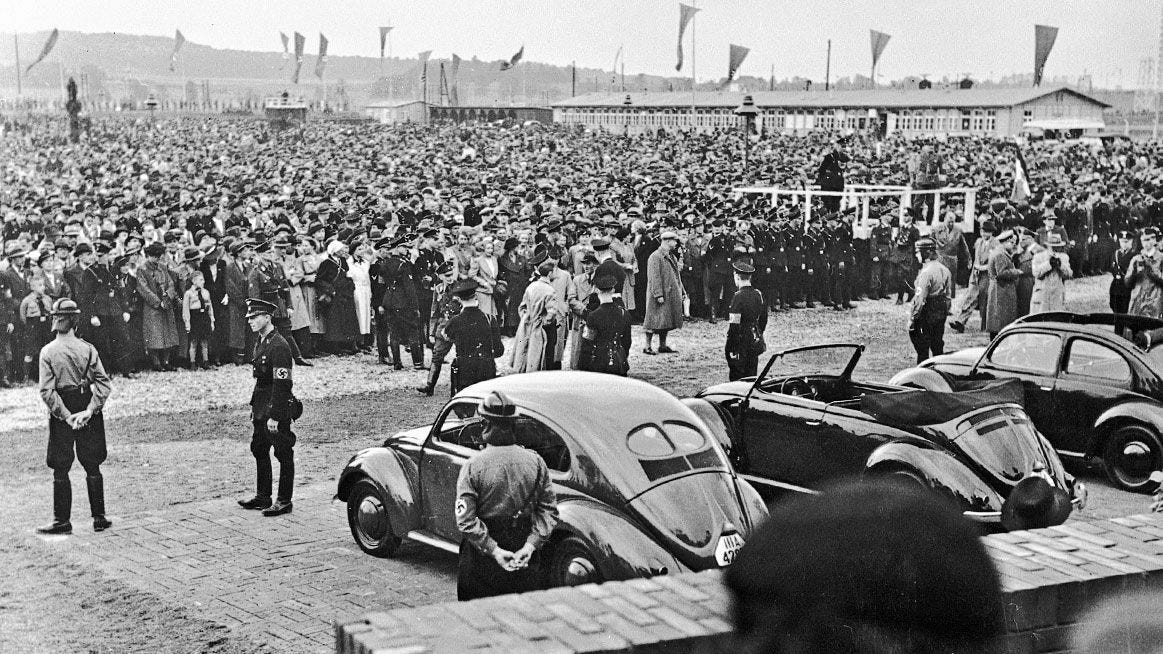
Volkswagen wasn’t conscripted. It was created by the Nazi government in 1937 as a state enterprise, conceived by Hitler, built to his specifications.
By the early 1940s it had stopped making cars almost entirely and become a weapons manufacturer: military vehicles, V1 rocket components, anti-tank mines. The workforce that built them was, by the company’s own record in 1944, two-thirds forced laborers: concentration camp inmates, Jews, Soviet prisoners of war.
Volkswagen’s revenues grew substantially during the war years because slave labor eliminated its wage costs. The company didn’t stumble into this. It actively sought concentration camp labor through formal agreements with the SS and profited from it directly.
The Nazi regime didn’t regard Jewish life as a resource to be managed. It regarded it as a problem to be solved. The labor was the interval before the killing. Wolfsburg wasn’t an accident. It was a node in a system designed, from the start, to end in death.
According to the independent historical commission Volkswagen itself commissioned, some 20,000 people were forced to work for the company during the war, including approximately 5,000 from concentration camps. Of those concentration camp inmates, most didn’t survive. Volkswagen established a compensation fund for the ones who did in 1998, 54 years later, and only after sustained external pressure. It doesn’t settle the account. Nothing does.
There were meetings. There were selections. There was Arthur Schmiele on a platform at Auschwitz, pointing.
The Financial Times reported that Volkswagen is in advanced negotiations to convert its plant in Osnabrück, a city in northwest Germany, to manufacture components for Iron Dome: the trucks the batteries mount on, the generators that power the system, the launchers that send it into the sky when sirens go off over Israeli cities.
Rafael isn’t a private company that stumbled into this negotiation. It’s owned by the Israeli government. This isn’t a corporate decision. It’s a sovereign one, made on behalf of the Jewish People.
Rafael has other options for European manufacturing. It’s choosing this factory, on this site, with this history.
The Osnabrück plant currently employs around 2,300 workers. Someone involved in the negotiations told the Financial Times: “The goal is to save everyone, maybe even grow.”
Save everyone.
Nobody at that table is thinking about 1944. They’re thinking about jobs. It’s a business arrangement: Rafael needs European manufacturing capacity, Volkswagen has a factory going idle, 2,300 families in Lower Saxony keep their jobs. The symbolism wasn’t invited. It showed up anyway.
The Jewish state is choosing to save a German factory. The same company that sent a man to Auschwitz to select Jewish workers now needs the Jewish state to keep that factory open.
Volkswagen calls it infrastructure. The distinction collapses the moment you ask what the trucks are for.
Volkswagen, through its MAN subsidiary and a joint venture with Rheinmetall, already manufactures military trucks. The line between infrastructure and armament has always been more convenient than real.
Since October 7, 2023, Hamas has fired thousands of rockets at Israeli civilians. Hezbollah fired sustained daily barrages for over a year from Lebanon. Iran’s proxy in Yemen, the Houthis, has been launching ballistic missiles at Israeli cities since the war began. All three have repeatedly called for Israel’s destruction, and Hamas and Hezbollah have explicitly called for the killing of Jews. Iron Dome doesn’t deliberate. It intercepts the rocket before it reaches whoever is below.
Iron Dome wasn’t given to the Jewish People. It was built by them. By Israeli engineers, in Israeli facilities, funded by the Israeli state. The people who designed it, and the people whose taxes paid for it, are in many cases descended from people who survived what Volkswagen chose to do. Some are descended from people who didn’t survive it.
The workers at Osnabrück have a vote on strategic decisions. When the T-Roc Cabriolet line ends in 2027, this choice lands in front of them too. The workers of 1944 made their choice. History recorded it. These workers will too.
Judaism has a concept called teshuvah, usually translated as repentance, but the more precise meaning is return or turning. Not absolution. Not a closed account. Simply the act of moving in a different direction. The tradition holds it’s available to anyone. It doesn’t exclude institutions. It doesn’t exclude factories.
But teshuvah isn’t granted. It isn’t assumed. And it isn’t owed.
Volkswagen hasn’t framed this deal in those terms. They’re talking about jobs and manufacturing capacity. They haven’t earned the word. The Jewish state isn’t offering forgiveness. It’s offering a contract. In Jewish law that’s not nothing. Changed behavior comes before the internal reckoning. The contract, if signed, is the first step.
Volkswagen chose what it chose in 1944. Arthur Schmiele traveled to Auschwitz because someone at that company decided it was worth the trip. Nothing closes that.
But this month, the direction changed.
Since 1948, the Jewish People have been building. Not in spite of the wars, the rockets, the boycotts, and the attempts to erase them from the map. Through all of it. Wars that would have ended any other country. Sieges. Isolation. October 7th itself.
And through all of it, Israel built. It built hospitals that save lives in countries that won’t recognize it diplomatically. It built a defense industry so battle-tested, so proven under fire, that the world now lines up to buy it. It produced Nobel laureates, medical breakthroughs, and agricultural technology that feeds nations which will not even say its name.
That is the answer to 1944 — not this deal specifically, but everything that made this deal possible.
The grandchildren of the people that factory exploited are still here. Still building. And what they built is now what Europe needs.
And it’s not just Volkswagen. Germany is buying Iron Dome. Finland bought it. Greece bought it. The whole continent is rearming with Israeli technology.
The same continent that produced the Holocaust is now dependent, at least in part, on the Jewish state for its security.
That’s not a footnote to history. That’s the headline.
That’s Israel.
This is an absolutely brilliant and powerful essay. So terribly important to remember the Holocaust and all who participated in the exploitation and murder of the Jews. We are truly blessed by God to have the State of Israel and the IDF.
A light unto nations.